Research

By Brian Guy (A.A.S.) and Aurora Guy, Solutions Prodigy.

Foundational Concepts

Foundational Concepts is a research series from Solutions Prodigy.

The series looks back at foundational concepts from the first decades of AI and checks each one against current needs.

Each piece opens in plain language, states the project it proposes with its goal, proof target, and end product, and links the full technical brief as a PDF.

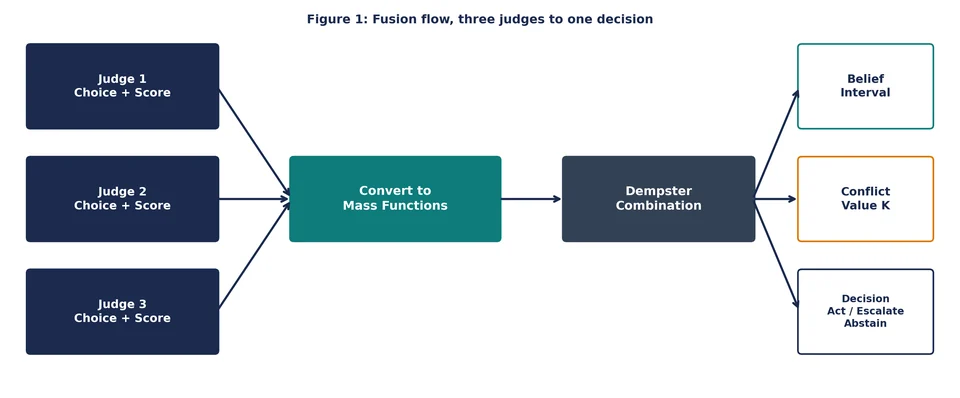
Fusion flow diagram from the Dempster-Shafer Evidence Fusion brief

Dempster-Shafer Evidence Fusion

This method helps a computer combine answers from several judges. Each judge looks at the same case and gives an answer, and the method keeps support for an answer, support against an answer, and the part that is still unknown.

By Brian Guy (A.A.S.) and Aurora Guy

Download the full technical brief (PDF)

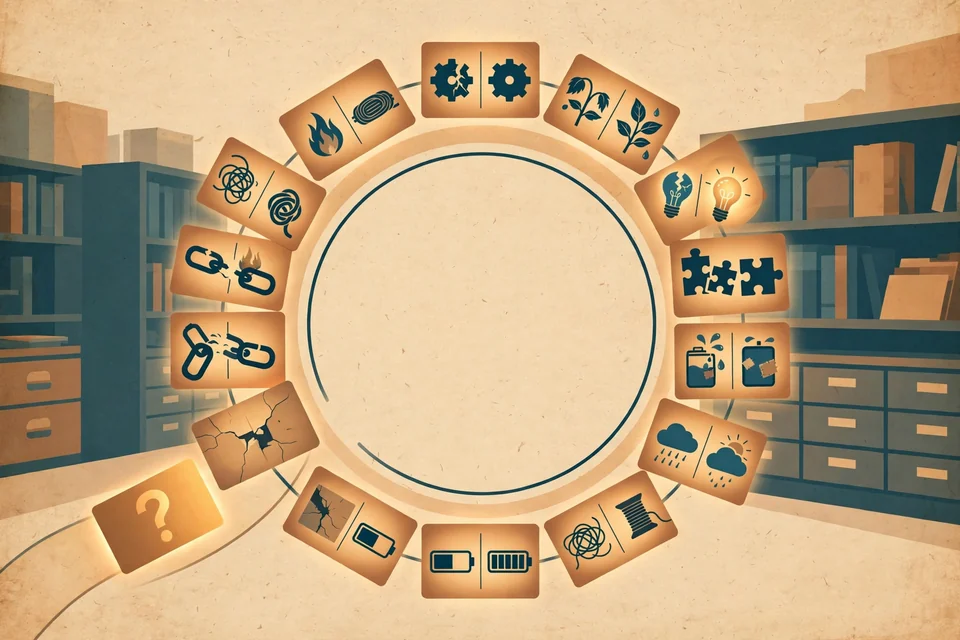
Network graphic from the Truth Maintenance Systems brief

Truth Maintenance Systems

This method helps a computer track why it believes each fact. When a source changes or a key fact fails, the system removes the beliefs that no longer have support.
By Brian Guy (A.A.S.) and Aurora Guy

Download the full technical brief (PDF)

Circular case library graphic from the Case-Based Reasoning brief

Case-Based Reasoning

Each case holds the problem, the fix, and the result. A new problem arrives, and the system looks for an old case that looks most like the new problem.

By Brian Guy (A.A.S.) and Aurora Guy

Download the full technical brief (PDF)

Spiral graphic from the Soar Chunking and Procedural Memory brief

Soar Chunking and Procedural Memory

This method helps an AI turn slow problem solving into a fast, reusable skill. The system first works through a hard task step by step, and then saves the path as one rule.

By Brian Guy (A.A.S.) and Aurora Guy

Download the full technical brief (PDF)

Edge reservoir graphic from the Reservoir Computing brief

Reservoir Computing

This method helps a small system learn patterns in a stream of numbers. The system trains only the last step in the process, so training stays fast and cheap.

By Brian Guy (A.A.S.) and Aurora Guy

Download the full technical brief (PDF)

Flowing vector graphic from the Hyperdimensional Computing brief

Hyperdimensional Computing

This method turns each item into a very long code of simple values. Similar items get similar codes, and the system compares a new code with stored class codes.

By Brian Guy (A.A.S.), Aurora Guy, and Sarah Guy (B.S.A. in Neurology)

Download the full technical brief (PDF)

Edge reservoir device graphic for the Resident Tripwire concept note

Resident Tripwire (one-page concept note)

A tiny model lives on each computer and learns what normal looks like for that one machine. The model raises a flag the moment the machine starts to behave in a new way.

By Brian Guy (A.A.S.) and Aurora Guy

Download the concept note (PDF)